Introduction
Citizen Science Volunteers can help with the conservation research and join an 8-day expedition to do wildlife surveys and visit with local communities. Expeditions are led by Dr Richard Bodmer and the science staff team and usually have 8-12 volunteers. You will experience tropical biodiversity, local communities and active Amazon conservation.
On terrestrial transect surveys we will walk on trails in the rainforest and look for primates, large birds, and any other mammal that is there. The trails are about 5km round-trip and we walk slowly to find the animals. When we see an animal we record its distance from the trail, habitat, and how many there were, among other information.
.
.
Sustainability
.
.
Accomodation
.
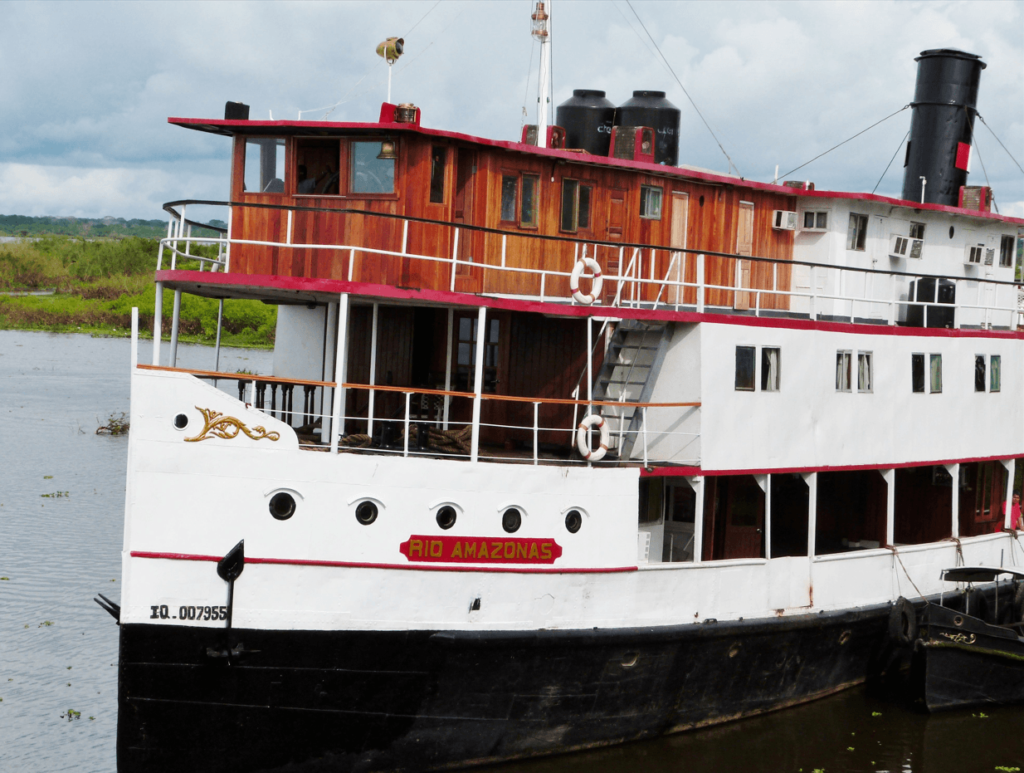
The Research Station is based on the historic steamboat ‘Rio Amazonas’ that is moored at the Yarapa River Research Reserve next to the Amazon. You travel to and from the research station in a boat.
The ‘Rio Amazonas’ has been restored to its Victoria ambiance and has en-suite cabins, spacious dining room, lecture room, library/laboratory, and plenty of open deck areas.
.
.
What You Will Do
You will work with knowledgeable scientists on surveys of dolphins, macaws, caimans, shorebirds, primates, terrestrial mammals, forest birds, frogs, bats, and fish, among others. You will learn about hunting and fishing by Indigenous people, and community-based and protected area conservation.
.
Contribution to Science
Your help collecting data and working with the research teams are vital for our long-term research to help save the Amazon. You do not need past experience, we teach you the methods and all you need to know for the surveys. Students, teachers and others can apply for a Fundamazonia fellowship to help cover fees.
.
Student Expeditions
Students can conduct BSc, MSc, PhD and Post-Doc projects at the Research Station. Students can either become involved in on-going research or develop their own projects around their individual interests. Students conducting research can use data from previous years for comparisons and multi-year analyses. This is especially important for studies on climate change. Fundamazonia fellowship support can help cover fees of student projects.
Unique Views of Amazon Forest
.
Understanding Culture of Indeginious Peoples
.
.
Cameras
Camera traps look at recent videos of animals filmed at the study site, including jaguar, peccaries, guans, and much more. We use camera traps to count the animals that live on the forest floor, which are difficult to spot by visual observation.
.
Not a Disney Cruise
.